
Curtains and Sensors
Which Aqara Smart Curtain Solution Do You Need?
Compare Aqara motorised curtain tracks, Curtain Driver E1 and Roller Shade Driver E1 by window type, power, hardware and service access.
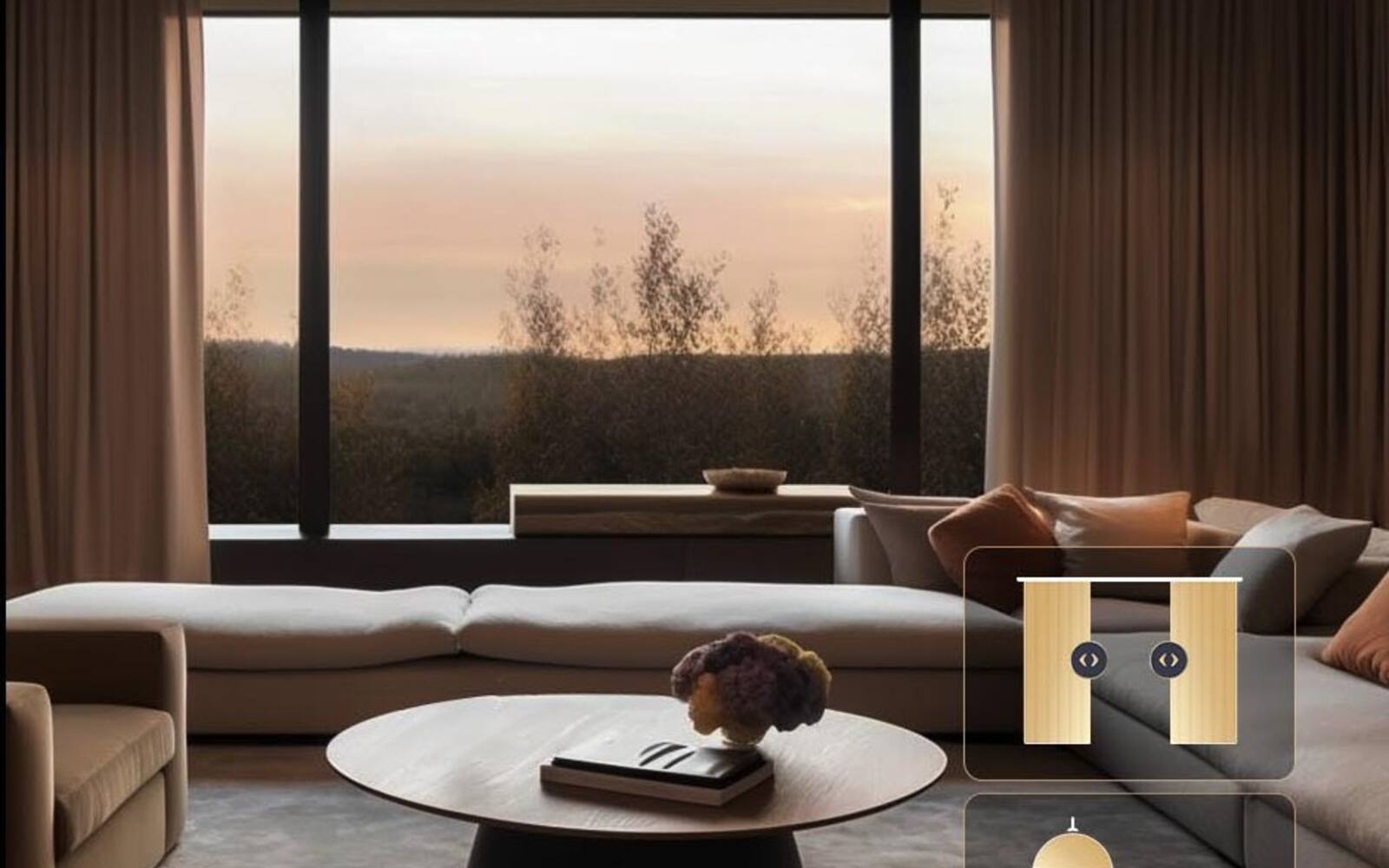
Which smart curtain product you need depends on what's hanging at the window. Full-height fabric curtains, a curtain track you already have and a roller blind with a beaded chain each need a different motor, and they fit into a renovation in different ways.
This guide helps you pick the right type. Before ordering, you'll still need to check it against your actual window: the track length, how heavy the curtains are, how much space the fabric takes up when drawn open (the stack-back), and where power and access will come from.
On this page
- Curtains, roller blinds and other shades move differently
- Smart Curtain Controller and C3: complete motorised tracks
- Curtain Driver E1 for curtains you already have
- Roller Shade Driver E1 and beaded-chain blinds
- Power, pelmet depth and getting to the motor later
- Opening by hand, and what happens when something goes wrong
- Scenes, schedules and wall buttons come last
Curtains, roller blinds and other shades move differently
Fabric curtains slide sideways along a rod or track. Roller blinds wind round a tube and go up and down. Venetian, honeycomb, zip and day-night shades may lift in other ways again. The motor has to work with the hardware you actually have; no app setting will let a curtain driver operate a blind without the right chain or track.
For curtains, note whether they open from one side or from the centre, whether a day and a night layer both need to move, how long and roughly how heavy they are, and where the fabric bunches when open. For a roller blind, note the chain type, bead size, loop length, which side the bracket is on and how much effort it takes to lift the blind.
Shop Aqara smart curtains and blinds
| Option | What it moves | Power | What changes at the window | When to do it |
|---|---|---|---|---|
| Smart Curtain Controller / Curtain Controller C3 | Fabric curtains on a purpose-built motorised track | Permanent mains power | Track, motor and carriers chosen as one set | Renovation or curtain replacement |
| Curtain Driver E1 | Compatible existing rod or track | Rechargeable battery via USB-C | Driver clamps to the existing hardware | Any time after the curtains are up |
| Roller Shade Driver E1 | Compatible plastic or metal beaded-chain roller blind | Rechargeable battery or constant USB-C | Driver mounts beside the blind and holds the chain taut | Retrofit, if the chain runs suitably |
| Built-in roller or curtain motor | Purpose-made curtain, roller or specialist shade hardware | Permanent power you can reach | Motor, tube or track built into the curtain or blind | Before the pelmet and ceiling are closed up |
Smart Curtain Controller and C3: complete motorised tracks
A complete track system comes with the motor, track, carriers, belt and end stops designed to work together. It's the best choice for a new renovation, a long window, heavy fabric or curtains that open from the centre, because the whole thing is sized as one unit rather than a motor added to a hand-pulled track.
The Smart Curtain Controller and Curtain Controller C3 we sell are both permanent track systems, and the C3 is the newer premium option. Check the exact motor, track and control details on your project quotation, since the finished system depends on the track length, which way the curtains open and how heavy they are, not just on the motor.
You'll need a power point near the motor end that isn't on a wall switch, and the connector, motor release and isolator have to stay within reach. Decide whether the motor goes on the left or the right before the curtain supplier measures up. With centre-opening curtains, check the width of both gathered panels so the motor can hide behind the fabric where the design allows.
Curtain Driver E1 for curtains you already have
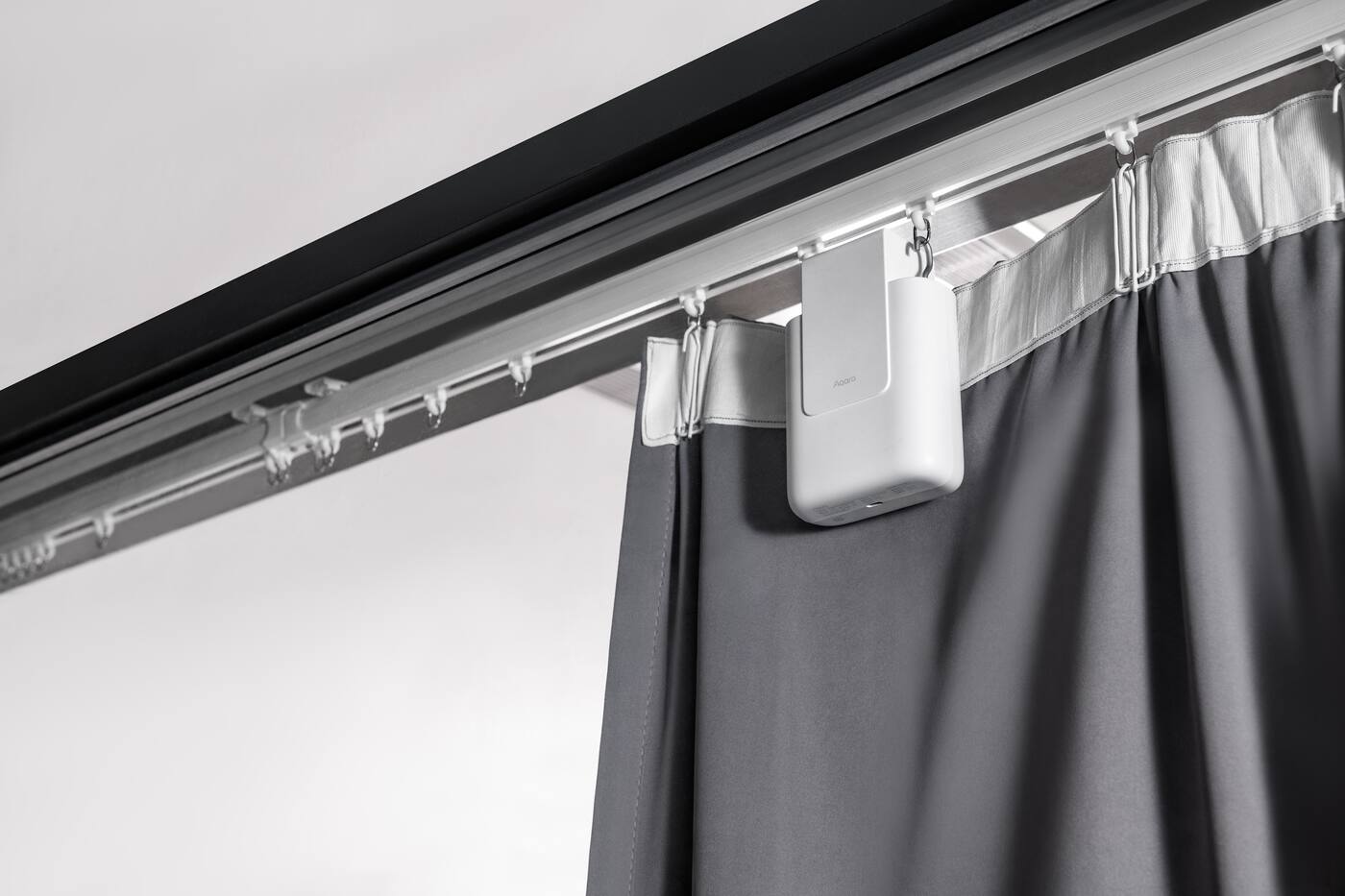
Curtain Driver E1 is a rechargeable motor that sits on your existing rail or rod and pushes or pulls the curtain along it. The track and rod versions use different adapters. You keep your current curtain hardware, which makes it a good fit for a finished home where nobody put in power for a motor.
Whether it works depends on the rail's profile, how the carriers are spaced, how smooth the joints are, how heavy the curtain is and how much force it takes to move. If your curtain already sticks at a rail joint when you pull it by hand, a motor won't make it reliable. Centre-opening curtains normally need two drivers, set up as a pair.
Aqara rates Curtain Driver E1 for curtains up to 12 kg under its conditions. Treat that as the upper limit, not a target, especially on a rough or heavily curved track. You also have to reach the driver to charge it, which gets awkward behind a deep pelmet or under a high ceiling.
Roller Shade Driver E1 and beaded-chain blinds
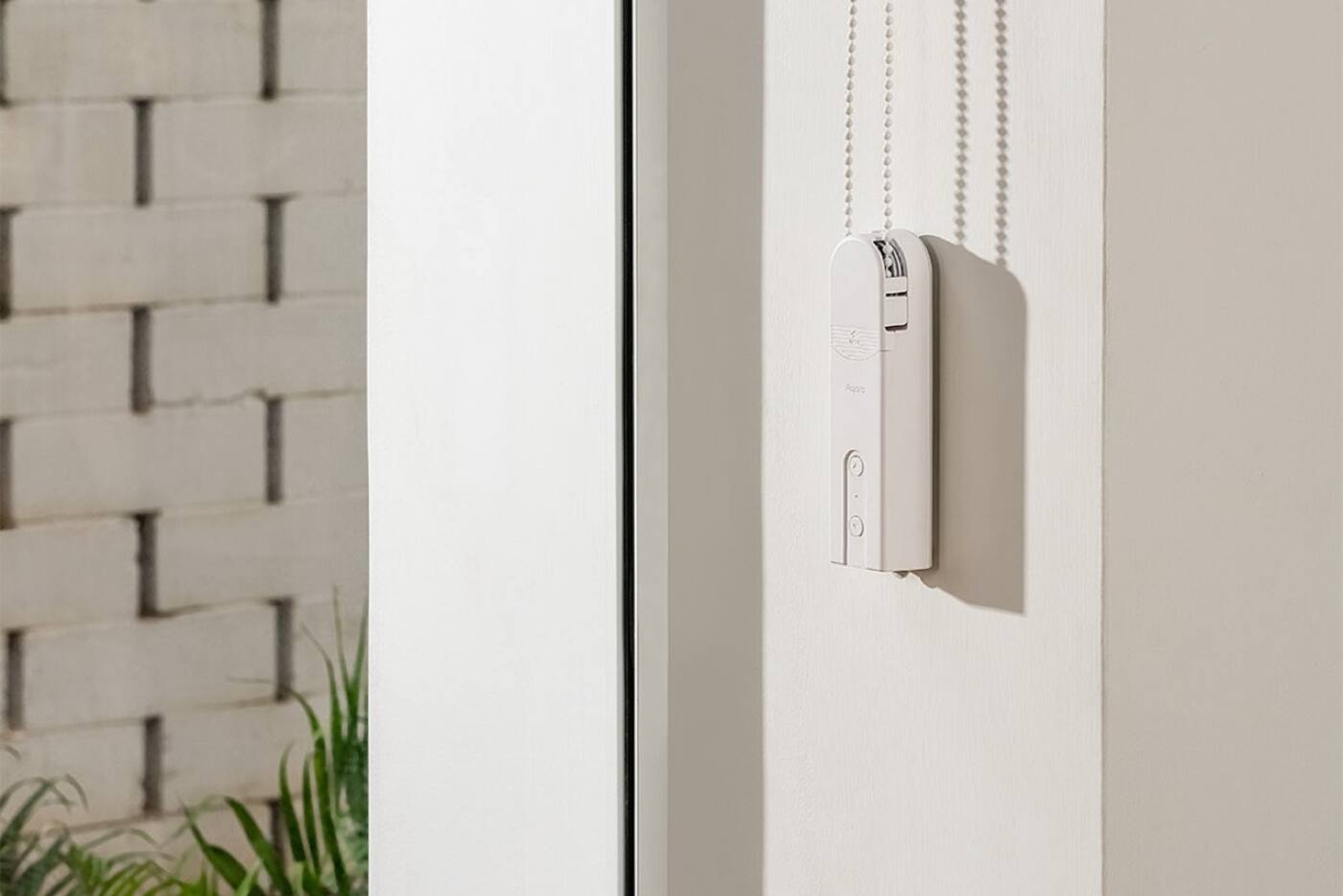
Roller Shade Driver E1 mounts beside a roller blind and pulls its continuous beaded chain for you. Aqara supplies adapters for common plastic and metal bead sizes, but the chain still needs enough straight length, tension and clearance from the wall for the driver to grip it without slipping.
It works on the blind you already have; it isn't a motor inside the roller tube. You'll see it at the side of the window, along with the route for its USB charging cable, so make sure you're happy with how that looks. Aqara's two-month battery figure assumes a 1.8 m by 1.8 m blind moving once a day. A bigger blind, more friction or more frequent use will change that.
For a wide, heavy or hidden roller blind, go for a purpose-built tube motor with power you can reach instead. A chain driver won't fix a blind that's already hard to pull by hand.
Power, pelmet depth and getting to the motor later
A permanent motor needs power on whichever side you put it. A rechargeable driver needs room for you to take it off or reach its charging port. Either way, you have to be able to get to it once the curtains and pelmet are finished. Hiding the motor is fine; sealing it behind fixed carpentry isn't.
Check the distance from the ceiling to the track, how deep the pelmet is and how much room the gathered curtains take. The motor can only hide behind the fabric if the track position, motor side and stack-back were planned together. Day-and-night curtains may need two tracks, two motors and a deeper pelmet.
Keep power connections away from spots where condensation or window leaks are likely, and label the isolator. Get the curtain supplier, electrician and smart home installer talking before any of them finalises their drawings.
Opening by hand, and what happens when something goes wrong
You should still be able to open a motorised curtain by hand. Some track motors respond to a gentle pull, and many systems let you move the curtain by hand when released or unpowered, but it depends on the motor and hardware. Ask the installer to show you how yours works, including how hard to pull.
Set the travel limits and opening direction after the final curtains are hung. Run it fully open and closed several times and listen for strain at the joints and end stops. Then try the wall control, the app, a scene and what happens when power comes back after a cut. A schedule shouldn't keep driving a curtain that's stuck against something.
Write down how to charge or switch off the motor, how paired centre-opening motors are grouped and which hub runs the automations. Fixing the curtain itself and fixing the app setup are separate jobs, and different people may handle them.
Scenes, schedules and wall buttons come last
Every option we sell works in Aqara scenes and automations through a compatible Aqara hub. Schedules, sunrise and sunset triggers, wall buttons, voice control and sensor conditions are all useful once the motor has reliable travel limits and the curtain or blind runs smoothly.
Percentages only mean something once calibration is stable, and even then 50 per cent is half the motor's travel, not half the daylight or half the fabric. If the amount of daylight matters to you, try positions in the actual room and adjust the target instead of assuming a percentage looks the same everywhere.
If you're renovating, decide how people will open the curtains day to day: an Aqara wall button, a programmable switch, a panel or simply pulling them. Guests shouldn't need the app to open a curtain.
Match the motor to what's on the window
New fabric curtains
- A purpose-built Aqara motorised track
- Permanent power on the motor side
- Track, stack-back and pelmet planned together
Curtains already up
- Curtain Driver E1 on a rod or track you've confirmed is compatible
- One driver or two, depending on how they open
- Easy to reach for charging, and smooth to pull by hand
Roller blinds
- Roller Shade Driver E1 for a suitable beaded chain
- A built-in tube motor for heavy or hidden blinds
- A straight chain run and power you can reach
The right product is the one that suits how your curtain or blind works and still lets you get to it later. The least visible motor isn't automatically the best.
Official references
Product and standards information was checked against these primary sources. The article above is original Aqara Singapore editorial content.
Measure before ordering
Choose the motor to suit your curtain hardware.
Compare the Aqara curtain and blind products, or send us the window width, curtain type, photos of the track and where you are in your renovation for review.