We’re often asked how long sealants last. The short answer: from a few years to decades, depending on conditions.
There’s no single lifespan figure. Weathering, UV exposure, constant joint movement and mechanical abrasion all shorten it.
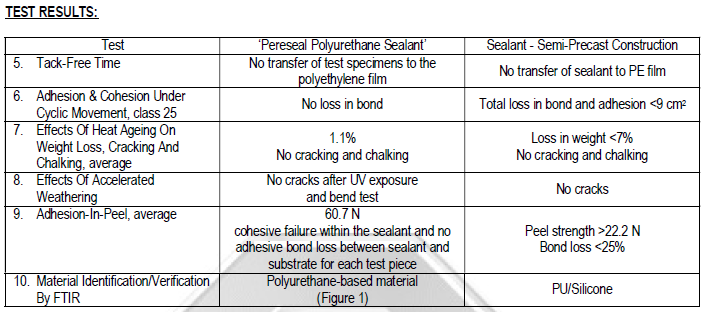
What we do have are test reports. We send our sealants to TÜV SÜD PSB for testing to ASTM C920 : 2008 Standard Specification For Elastomeric Joint Sealants. These tests don’t give a number of years. They put samples through accelerated stress under controlled conditions, which shows how well a sealant holds up. Three tests in each report deal with durability.
6: Cyclic adhesion and cohesion
Adopted ASTM C719 : 2005 Standard Test Method for Adhesion And Cohesion Of Elastomeric Joint Sealants Under Cyclic Movement (Hockman Cycle).
The sealant is repeatedly stretched and compressed under a range of conditions over a few weeks. To pass, it must show no loss of bond: no adhesion or cohesion failure.
7: Effects of heat ageing
ASTM C1246 : 2017 Standard Test Method For Effects Of Heat Ageing On Weight Loss, Cracking, And Chalking Of Elastomeric Sealants After Cure
The sealant is heated to 70°C for 21 days. To pass, it must show no cracking or chalking.
8: Effects of accelerated weathering
Adopted ASTM C793 : 2005 (2017) Standard Test Method For Effects Of Accelerated Weathering On Elastomeric Joint Sealants
The sealant goes through repeated cycles of UV and condensation for more than 30 days. To pass, it must not crack.
You’ll find the test reports on each product page where available. Here’s an extract from the Pereseal PU report: